All photos courtesy of Boeing
All photos courtesy of Boeing 
Boeing, Air China Sign Agreement for 747-8 Intercontinentals
Air China to become first Chinese customer for Boeing's newest jumbo jet
HONG KONG, March 7, 2011 /PRNewswire/ -- Boeing (NYSE: BA) and Air China today signed an agreement for the purchase of five 747-8 Intercontinental jetliners. Air China is the first Chinese carrier to contract the passenger version of the new, fuel-efficient 747-8.
The agreement requires Chinese government approval, at which time it will be posted to the Boeing Orders & Deliveries website.
"Air China has been operating 747s since the 1980s," said He Li, vice president of Air China. "The new, high capacity Boeing 747-8 Intercontinental will deliver exceptional economics and a great flying experience to our customers."
Air China, the flag carrier of the People's Republic of China, will use the airplanes to expand its international routes.
"The technologically advanced 747-8 Intercontinental will deliver improved operating economics, efficiency and environmental performance in support of Air China's continued growth," said Marlin Dailey, vice president of Sales & Marketing, Boeing Commercial Airplanes. "Air China has become one of the fastest growing airlines in the world and today is one of the world's largest carriers. We're proud to be part of their success and look forward to continuing our long and enduring partnership."
The new 747-8 Intercontinental carries 467 passengers in a three-class configuration. The airplane features a new wing design and an upgraded flight deck. The airplane interior incorporates features from the 787 Dreamliner including a new curved, upswept architecture that will give passengers a greater sense of space and comfort, while adding more room for personal belongings. The architecture will be accentuated by lighting technology that provides smooth transitions for a more restful flight.
Using 787-technology GEnx-2B engines, the airplane will be quieter, produce lower emissions and achieve better fuel economy than any competing jetliner. It also increases cargo volume by 26 percent.

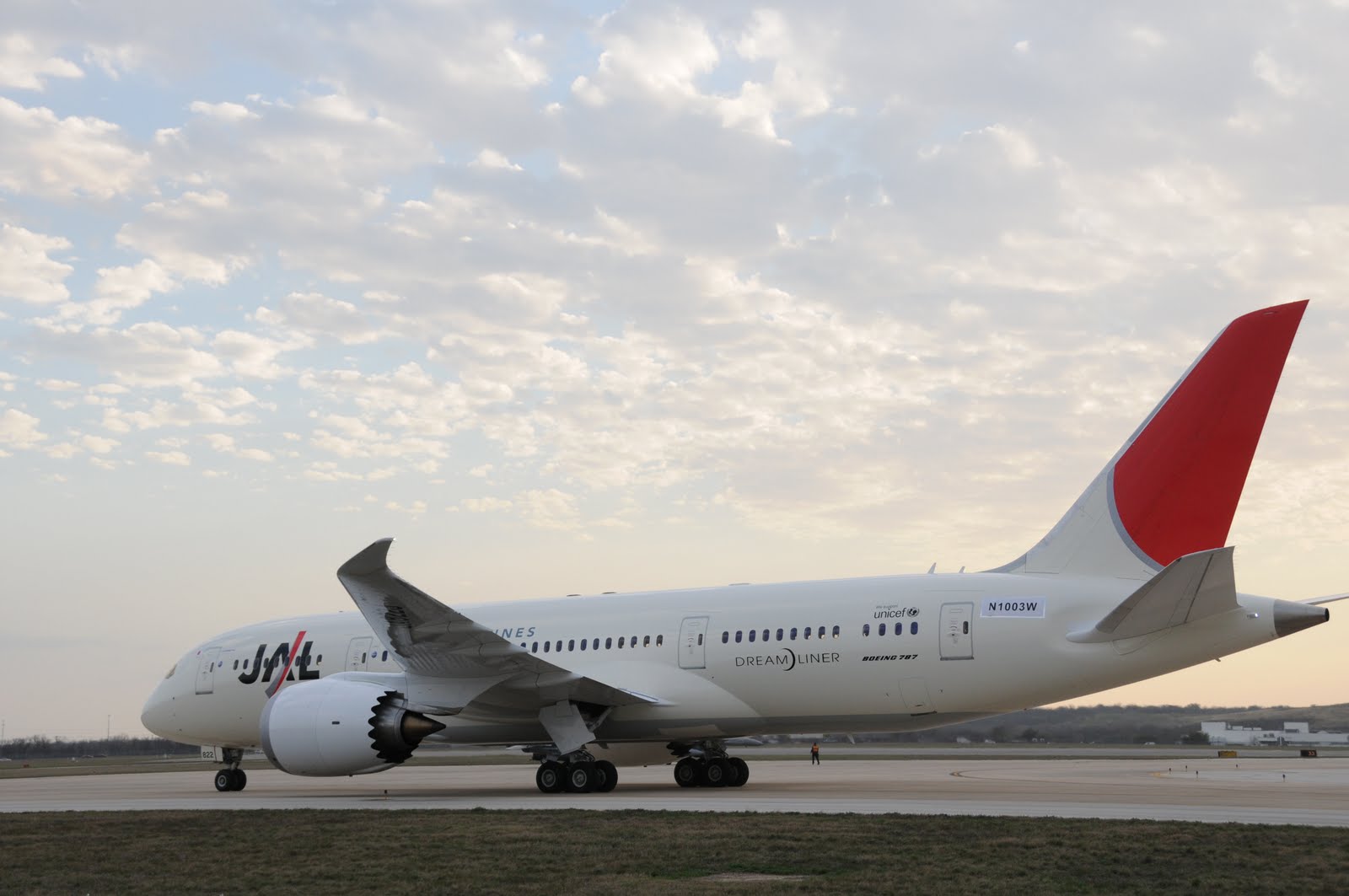
ZA177 in San Antonio for Change Incorporation (Boeing Photos)Boeing Begins Change Incorporation Work on 787 Dreamliner
787 program continues steady progress toward certification and delivery
EVERETT, Wash., March 7, 2011 /PRNewswire/ -- Today, Boeing (NYSE: BA) began change incorporation work on the 787 Dreamliner at Boeing's Global Services & Support site in San Antonio, Texas. Airplane #23, the first 787 to undergo change incorporation, on Friday flew from Everett, Wash., to San Antonio on a ferry flight. During change incorporation, airplanes that are not part of flight test are configured to conform with the standards established as part of type certification efforts. Refurbishment of three of the six 787 flight test airplanes also will take place in San Antonio after completion of flight test activities.
"The 787 team is thrilled to have the expertise and enthusiasm of the San Antonio team focused on getting these airplanes ready for delivery to our customers," said Scott Fancher, vice president and general manager of the 787 program.
The current plan is for six Dreamliners to complete change incorporation and refurbishment in San Antonio. Three will complete change incorporation and three airplanes will be refurbished after flight test is complete. However, the plan is flexible and could accommodate additional 787 production needs as flight test is completed and airplanes are prepared for delivery. The work will be performed from March 2011 through 2013.
"We continuously look for ways to leverage the strength of the Boeing enterprise, taking advantage of the team and the skills we have across the company," said Fancher. "San Antonio specializes in modification work and has the capability and capacity to get the job done. The team was a natural choice."
Some of the work done in San Antonio will include installing electronic and mechanical equipment, completing software upgrades, testing functional systems, and removing and reworking wiring or equipment that needs to be updated to current configuration requirements. Approximately 450 employees will be hired on a temporary basis to join with 1,700 experienced workers at the site to complete the work.
"Everyone on our team is excited to join the 787 program," said Kevin Devine, vice president and general manager of the San Antonio site. "This airplane is about as advanced as you can get and there are high expectations tied to this work package. I am confident that our team will get the job done."
Currently, there are about 1,500 employees at Boeing's San Antonio site performing maintenance and modification work on the following programs: KC-135 Programmed Depot Maintenance, KC-135 Global Air Traffic Management, C-17 Globemaster III Sustainment Partnership and the C-130 Avionics Modernization program.
Boeing PhotoBoeing Completes 1,000th 787 Flight
EVERETT, Wash., Feb. 24, 2011 /PRNewswire/ -- The Boeing (NYSE: BA) 787 Dreamliner made its 1,000th flight yesterday, marking another milestone in the flight test program. There are seven airplanes participating in flight testing. The landing of 787 flight test airplane ZA004, just after 1 p.m. MST at Yuma International Airport, counted as the official 1,000th flight.
The program is near its 3,000th hour of flying and 787s have flown a total of more than one million miles.
"The team is making great progress," said Scott Fancher, vice president and general manager of the 787 program. "We are getting through the test conditions needed to certify this airplane with nearly 80 percent of the conditions for the first model, with Rolls-Royce engines, already complete. And, we're more than 60 percent of the way through the test conditions for the 787s with General Electric engines."
Capt. Mike Carriker, chief pilot for the 787, Boeing Test & Evaluation, said the airplane continues to behave well in testing.
"We're really eager to get this airplane through its flight testing so our customers can see for themselves this airplane's excellent performance," said Carriker.

Boeing Celebrates Premiere of New 747-8 Intercontinental
- Thousands gather for unveiling of only airplane to serve 400-500 seat market
- New 747 delivers unrivaled efficiency, new benchmark in environmental performance, welcoming interior for passengersEVERETT, Wash., Feb. 13, 2011 /PRNewswire/ -- Boeing (NYSE: BA) today unveiled its new 747-8 Intercontinental, the new high-capacity passenger airplane that offers airlines the lowest operating costs and best economics of any large passenger airplane while providing enhanced environmental performance.
Approximately 10,000 guests, including customers, Boeing employees, government officials, partners and suppliers, gathered in the factory in Everett, Wash., to witness the premiere of the Intercontinental at an event themed "Incredible, Again." Boeing Commercial Airplanes President and Chief Executive Officer Jim Albaugh said the newest 747 incorporates technological advancements that make it an extremely productive airplane for customers.
"The new 747-8 Intercontinental features the latest in innovative technologies — applying many of the breakthroughs also found on the 787 Dreamliner," said Albaugh. "We think our customers will value the low operating costs and passengers will enjoy the comfort of the striking new interior."
"The 747-8 Intercontinental will be a great complement to our fleet, fitting nicely into the 400-seat category, improving our fleet's eco-efficiency even further," said Nico Buchholz, executive vice president, Lufthansa Group Fleet Management. "As launch customer, we are looking forward to welcoming this new aircraft to our fleet next year as it adds to our ongoing fleet modernization and environmental efforts."
Korean Air and VIP customers have joined launch customer Lufthansa in ordering a total of 33 747-8 Intercontinentals. First delivery of the 747-8 Intercontinental is scheduled for the fourth quarter.
"As the only airplane in the 400 to 500-seat market, the 747-8 Intercontinental will give operators an airplane perfectly suited for long, heavily traveled routes around the world," said Pat Shanahan, vice president and general manager, Airplane Programs, Boeing Commercial Airplanes. "The new 747-8 Intercontinental will set a new standard in economic and environmental performance, while providing a world-class passenger experience."
The 747-8 Intercontinental will have the lowest seat-mile cost of any large commercial jetliner, with 12 percent lower costs than its predecessor, the 747-400. The airplane provides 16 percent better fuel economy, 16 percent less carbon emissions per passenger and generates a 30 percent smaller noise footprint than the 747-400. The 747-8 Intercontinental applies interior features from the 787 Dreamliner that includes a new curved, upswept architecture giving passengers a greater feeling of space and comfort, while adding more room for personal belongings.
The airplane unveiled today is painted in a new Sunrise livery of red-orange that only will appear on the first 747-8 Intercontinental and is a significant departure from Boeing's standard blue. The new color palette honors many key Boeing customers whose cultures recognize these colors as symbols of prosperity and good luck.
ZA004 is scheduled to receive the engines over a two week period (Feb. 23rd to March 11th). Previously, the installation and ground testing was to take about a month before resuming flights with the improved engines. If that schedule holds true this time around, then we could see ZA004 returning to the skies with the new engines around the last week of March. It will undertake much of the same testing that the 787 program conducted using the Trent 1000 package "A" as well as conducting ETOPs testing with the improved package "B" engines.Rolls-Royce’s Trent 1000 built to the improved ‘Package B’ standard is designed to bring performance to within 1% of Boeing’s original specification. Package B includes enhanced aerodynamics in the six-stage low pressure (LP) turbine, improved cooling flow for the IP turbine and changes to the secondary air system to take off sealing and cooling air at a lower pressure stage. The root-to-tip twist of the fan blade is also slightly altered to match changes in the pressure ratio caused by a concurrent reduction in nozzle area. Rolls has run at least three Package B performance engines and, when last reporting on progress, says all were in line with expectations. In March Rolls was flight testing the first Package B engine on its company 747 flying testbed ahead of delivering finalized engines to Boeing for installation on ZA004.
The Dreamliner flight test programme, he said, was in full swing with the aircraft having completed 2500 hours and another 300 hours were needed to be done after which they will get the Federal Aviation Administration certificate.Boeing has since accumulated just under 2700 flight hours on the 787 (as of yesterday) which implies another 100 flight test hours. I have to take it with a grain of salt though. It is unclear if Dinesh Keskar was including any ETOPs testing in that 300 hours (which Boeing has not yet started). I tend to think that it is not included and that ETOPs testing will add a couple hundred more hours to the total. Still I'm waiting to hear back from Boeing as I did put this question to them.
“Once that is obtained, which we are expecting this summer, then we can begin deliveries all over the world,” he said.
Boeing says they've completed 75% of required testing needed for delivery
787 high risk conditions mostly retired
787 production continues to improve
Currently 2/month production rate for 787
Still maintaining 787 10/month build rate by end of 2013
787-9 still targeted for delivery at end of 2013
747-8I first flight expected by end of March, 2011, first delivery still expected by end of year
Still expecting to deliver 747-8F by middle of 2011
Expect to be completed with 787 settlement negotiations with 787 suppliers by the end of the year
787 not in a forward loss position but profitability is under pressure
787 customer claim negotiations are still ongoing but are tracking to expectations
Expect 50/50 split between 787 and 747-8 deliveries this year (between 25 to 40 in total expected to be delivered)
Boeing expects 0 margins on early 787 and 747-8 deliveries (dilutive to 2011 earnings)
United says it expects its first 787 in 1Q12
787 ETOPS is fully in the schedule and will be delivered in 2011 with ETOPS certification
787 parts are coming in more completed then before
Boeing had a conservative view of 787 production ramp up but that margin is now eaten up with the slide in deliveries
Boeing has a clear view with 787 FAA certification.
ETOPS 0n 787 is different vs. 777 - fault and condition based for 787 ETOPS instead of cycle based for 777
Boeing and FAA are in agreement with testing requirements for ETOPS
Temporary fix of electrical issues is flying on 787s right now but permanent fix must be installed before ETOPS testing starts; most other testing is largely done
Boeing is still sorting out which 787 line number will be delivered first though they are close to finally figuring it outCommercial Airplanes' 2011 deliveries guidance is expected to be between 485 and 500 airplanes and is sold out. It includes the first 787 and 747-8 deliveries (combined 25 to 40 units), which are expected to begin in the third quarter of 2011 and mid-2011, respectively.
Boeing's 787 facility in North Charleston continues to take shape. to the left is a screen grab from the builder's web cam showing it's progress through this morning.Newest 787 Dreamliner Makes First FlightMatt Cawby shot video of ZA102's takeoff from Paine as well as photos of the aircraft's return.

The newest 787 - designated ZA102 - made its first flight today. The airplane took off from Paine Field at 3:53 p.m. (Pacific time) and landed just over one hour later at the same location (per the plan). ZA102 will be a temporary member of the flight test fleet and will be focused on helping to demonstrate 787 extended operations (ETOPS) and complete function and reliability testing. Earlier flight test airplanes were configured more uniquely for other testing required as part of the certification program.